

#Workplace Safety
By Team Seaglass
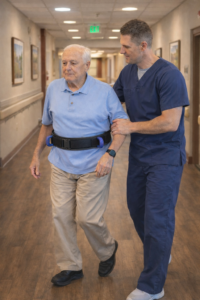 If you work in senior living or healthcare, you’ve probably used a gait belt many times. You may have been taught to “always use a belt” when helping someone walk. For years, gait belts have been seen as a safe and standard way to protect residents from falling. Many caregivers feel more confident when the belt is in place.
But today, we are learning more about safe patient handling. The real question is not whether gait belts are good or bad. The question is: When are they truly helpful — and when should we use something safer? Understanding the difference helps protect both the resident and your body.
What Evidence Shows
The Veterans Health Administration (VA) Safe Patient Handling guidance is clear: gait belts are not lifting devices. They are meant for guiding and steadying residents who can already stand and bear weight. When lifting help is needed, mechanical equipment like sit-to-stand lifts or full-body lifts are safer choices.
In short, the evidence tells us this: gait belts can help with supervision and balance — but they do not replace proper lift equipment. Using the right tool for the right level of mobility is what truly keeps everyone safe.
When is a Gait Belt Appropriate?
Use a gait belt when the resident:
- Can bear weight
- Can stand and walk on their own with supervision
The belt helps you:
- Guide the resident
- Keep them centered
- Give small balance cues
- Protect the resident’s dignity
When is a Gait Belt NOT Appropriate?
Do NOT use a gait belt:
- To lift a resident from a chair
- To pull a resident to a standing position
- As the only tool during a transfer
- To catch a falling resident
If the resident cannot stand without support, use:
- Sit-to-Stand lift
- Fully Body Mechanical Lift
- Other approved safe patient handling equipment
The Bottom Line?
Use the right tool for the right level of mobility. For more guidance on Safe Patient Handling & Mobility, see the following references:
- https://www.myamericannurse.com/gait-belts-101-a-tool-for-patient-and-nurse-safety/
- https://www.cdc.gov/niosh/healthcare/prevention/sphm.html
- https://mobile.va.gov/app/safe-patient-handling
- Miller H, Rockefeller K, Townsend P. Inter-national round table discussion: Do gait belts have a roll in safe patient handling programs? Int J Safe Patient Handl Mobil. 2017;7(3):116-21.
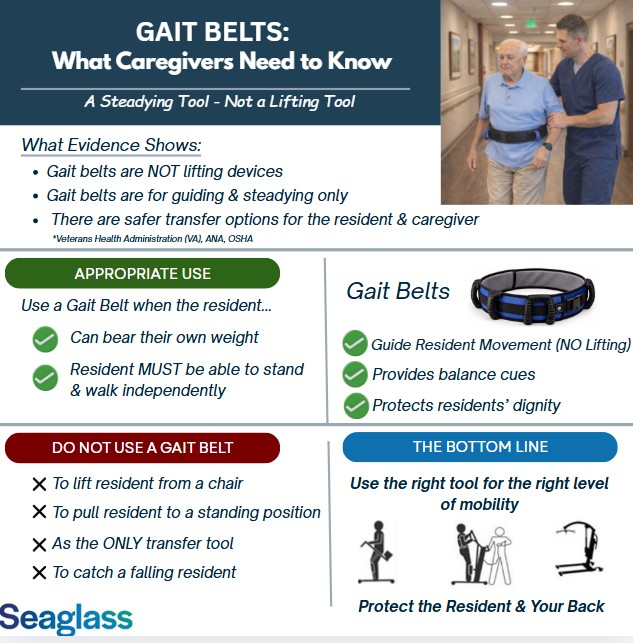 Click image to print